> ## Documentation Index
> Fetch the complete documentation index at: https://docs.urtentic.com/llms.txt
> Use this file to discover all available pages before exploring further.
# Getting Started Guide
> Walk through integrating the Urtentic API into your application step by step, with practical examples and code samples.
## Prerequisites
Before you begin, you'll need:
1. **Urtentic Account**: Sign up at [urtentic.com](https://app.urtentic.com)
2. **API Credentials**: Obtain your Client ID and API Secret from the integrations page in your dashboard
3. **Workflow ID**: Create a verification workflow in your dashboard
### Generate Your API Credentials
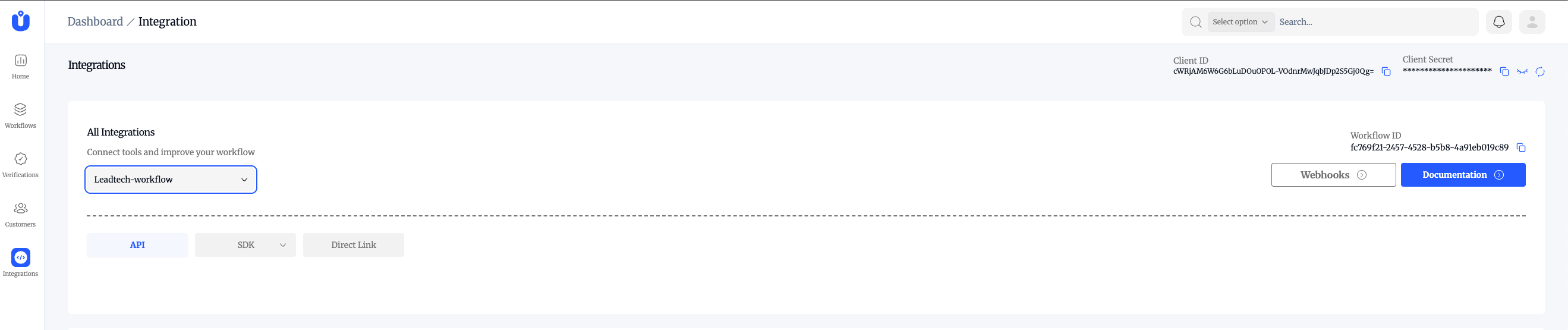 Navigate to the integrations page in your dashboard to obtain your API credentials:
* **Client ID**: Your application identifier (sent via `X-CLIENT-ID` header)
* **Client Secret**: Your authentication token (sent via `Authorization: Bearer` header)
### Create a Workflow
Navigate to the integrations page in your dashboard to obtain your API credentials:
* **Client ID**: Your application identifier (sent via `X-CLIENT-ID` header)
* **Client Secret**: Your authentication token (sent via `Authorization: Bearer` header)
### Create a Workflow
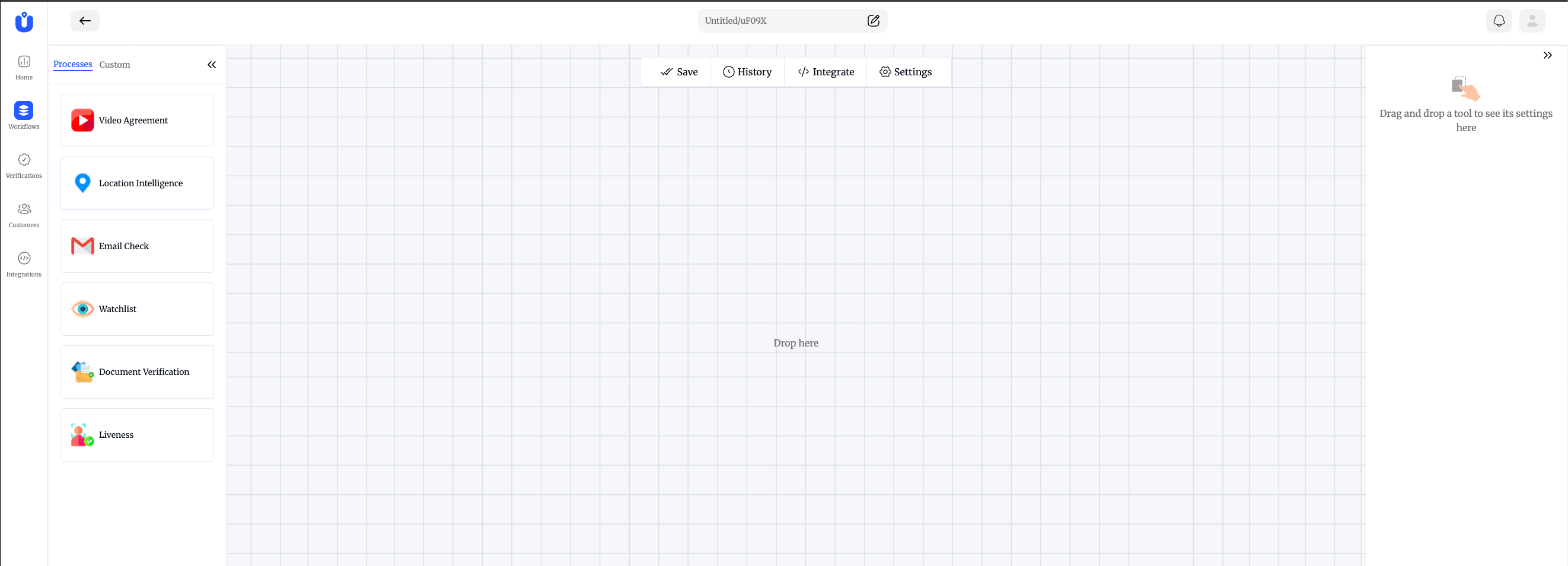 Set up your verification workflow by defining the required verification processes.
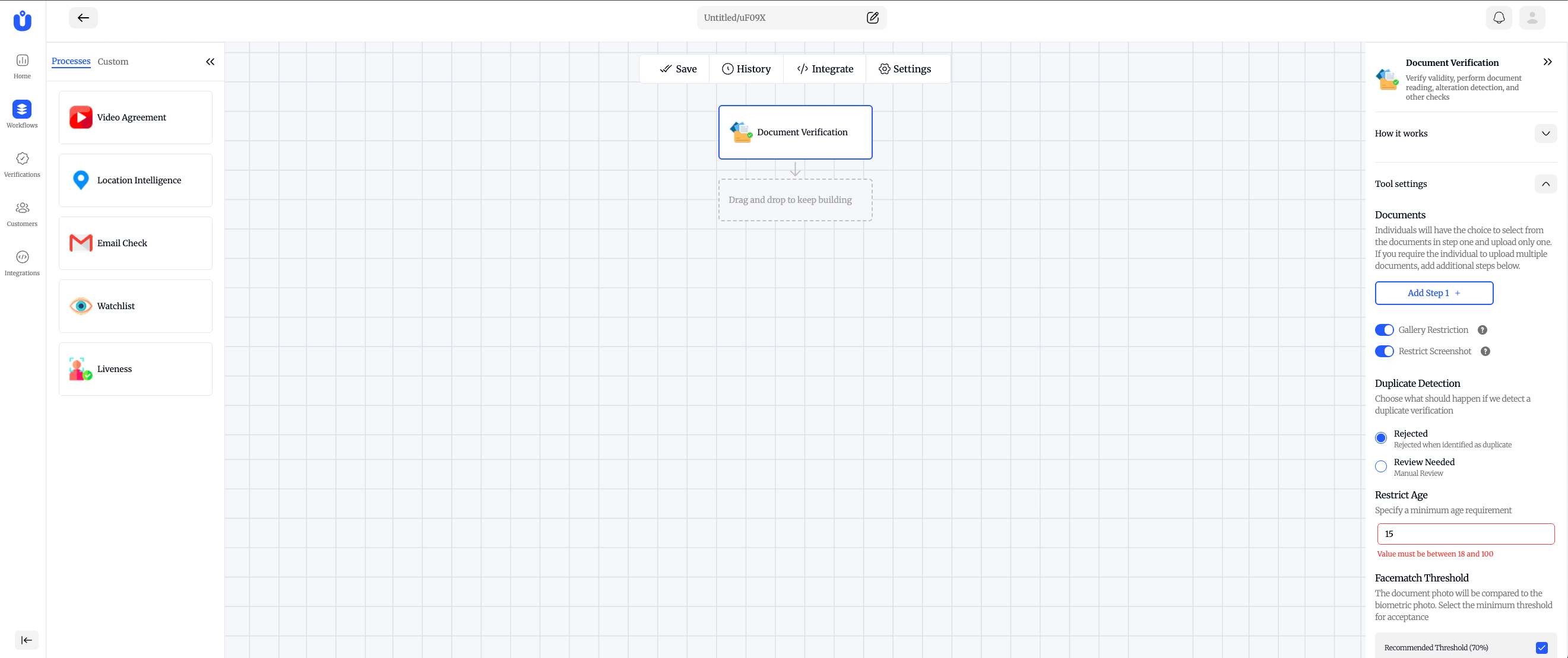 Configure your workflow settings including document types, verification steps, and security options.
## Quick Start (5 minutes)
### Step 1: Set Up Your Environment
First, set your API credentials as environment variables:
```bash theme={null}
export URTENTIC_API_KEY="your-base64-encoded-api-key"
export URTENTIC_CLIENT_ID="your-base64-encoded-client-id"
```
### Step 2: Create Your First Verification
```bash theme={null}
curl -X POST https://api.urtentic.com/api/v1/verifications \
-H "Authorization: Bearer $URTENTIC_API_KEY" \
-H "X-CLIENT-ID: $URTENTIC_CLIENT_ID" \
-H "Content-Type: application/json" \
-d '{
"flowId": "db50ed08-18fa-41e8-9e46-a44aca39f69d",
"metadata": {
"userId": "user_12345",
"applicationId": "app_67890"
}
}'
```
**Response:**
```json theme={null}
{
"id": "85c94e71-6e3f-4a19-b15c-781d8a876542",
"flowId": "db50ed08-18fa-41e8-9e46-a44aca39f69d",
"status": "pending",
"metadata": {
"userId": "user_12345",
"applicationId": "app_67890"
},
"createdAt": "2023-12-01T10:00:00Z",
"verificationUrl": "https://verify.urtentic.com?flowId=db50ed08-18fa-41e8-9e46-a44aca39f69d&clientId=YOUR_CLIENT_ID&metadata=%7B%22userId%22%3A%22user_12345%22%7D"
}
```
### Step 3: Check Verification Status
```bash theme={null}
curl -X GET https://api.urtentic.com/api/v1/verifications/85c94e71-6e3f-4a19-b15c-781d8a876542 \
-H "Authorization: Bearer $URTENTIC_API_KEY" \
-H "X-CLIENT-ID: $URTENTIC_CLIENT_ID"
```
## Integration Examples
```javascript Node.js theme={null}
const URTENTIC_API_KEY = process.env.URTENTIC_API_KEY;
const URTENTIC_CLIENT_ID = process.env.URTENTIC_CLIENT_ID;
const BASE_URL = 'https://api.urtentic.com/api/v1';
// Create a verification
async function createVerification(flowId, metadata = {}) {
const response = await fetch(`${BASE_URL}/verifications`, {
method: 'POST',
headers: {
'Authorization': `Bearer ${URTENTIC_API_KEY}`,
'X-CLIENT-ID': URTENTIC_CLIENT_ID,
'Content-Type': 'application/json'
},
body: JSON.stringify({ flowId, metadata })
});
return await response.json();
}
// Check verification status
async function getVerificationStatus(verificationId) {
const response = await fetch(`${BASE_URL}/verifications/${verificationId}`, {
headers: {
'Authorization': `Bearer ${URTENTIC_API_KEY}`,
'X-CLIENT-ID': URTENTIC_CLIENT_ID
}
});
return await response.json();
}
// Usage
const verification = await createVerification('db50ed08-18fa-41e8-9e46-a44aca39f69d', { userId: 'user_12345' });
console.log('Verification URL:', verification.verificationUrl);
```
```python Python theme={null}
import requests
import os
URTENTIC_API_KEY = os.getenv('URTENTIC_API_KEY')
URTENTIC_CLIENT_ID = os.getenv('URTENTIC_CLIENT_ID')
BASE_URL = 'https://api.urtentic.com/api/v1'
def create_verification(flow_id, metadata=None):
if metadata is None:
metadata = {}
response = requests.post(
f'{BASE_URL}/verifications',
headers={
'Authorization': f'Bearer {URTENTIC_API_KEY}',
'X-CLIENT-ID': URTENTIC_CLIENT_ID,
'Content-Type': 'application/json'
},
json={ 'flowId': flow_id, 'metadata': metadata }
)
return response.json()
def get_verification_status(verification_id):
response = requests.get(
f'{BASE_URL}/verifications/{verification_id}',
headers={
'Authorization': f'Bearer {URTENTIC_API_KEY}',
'X-CLIENT-ID': URTENTIC_CLIENT_ID
}
)
return response.json()
# Usage
verification = create_verification('db50ed08-18fa-41e8-9e46-a44aca39f69d', { 'userId': 'user_12345' })
print(f"Verification URL: {verification['verificationUrl']}")
```
```php PHP theme={null}
$flowId, 'metadata' => $metadata ];
$context = stream_context_create([
'http' => [
'method' => 'POST',
'header' => [
"Authorization: Bearer $apiKey",
"X-CLIENT-ID: $clientId",
'Content-Type: application/json'
],
'content' => json_encode($data)
]
]);
$response = file_get_contents("$baseUrl/verifications", false, $context);
return json_decode($response, true);
}
$verification = createVerification('db50ed08-18fa-41e8-9e46-a44aca39f69d', [ 'userId' => 'user_12345' ]);
echo "Verification URL: " . $verification['verificationUrl'] . PHP_EOL;
?>
```
```java Java theme={null}
import com.fasterxml.jackson.databind.ObjectMapper;
import java.net.URI;
import java.net.http.HttpClient;
import java.net.http.HttpRequest;
import java.net.http.HttpResponse;
import java.util.Map;
public class UrtenticClient {
private static final String API_KEY = System.getenv("URTENTIC_API_KEY");
private static final String CLIENT_ID = System.getenv("URTENTIC_CLIENT_ID");
private static final String BASE_URL = "https://api.urtentic.com/api/v1";
private final HttpClient httpClient = HttpClient.newHttpClient();
private final ObjectMapper mapper = new ObjectMapper();
// Create a verification
public Map createVerification(String flowId, Map metadata) throws Exception {
Map body = Map.of("flowId", flowId, "metadata", metadata);
String json = mapper.writeValueAsString(body);
HttpRequest request = HttpRequest.newBuilder()
.uri(URI.create(BASE_URL + "/verifications"))
.header("Authorization", "Bearer " + API_KEY)
.header("X-CLIENT-ID", CLIENT_ID)
.header("Content-Type", "application/json")
.POST(HttpRequest.BodyPublishers.ofString(json))
.build();
HttpResponse response = httpClient.send(request, HttpResponse.BodyHandlers.ofString());
return mapper.readValue(response.body(), Map.class);
}
// Check verification status
public Map getVerificationStatus(String verificationId) throws Exception {
HttpRequest request = HttpRequest.newBuilder()
.uri(URI.create(BASE_URL + "/verifications/" + verificationId))
.header("Authorization", "Bearer " + API_KEY)
.header("X-CLIENT-ID", CLIENT_ID)
.GET()
.build();
HttpResponse response = httpClient.send(request, HttpResponse.BodyHandlers.ofString());
return mapper.readValue(response.body(), Map.class);
}
// Usage
public static void main(String[] args) throws Exception {
UrtenticClient client = new UrtenticClient();
Map metadata = Map.of("userId", "user_12345");
Map verification = client.createVerification("db50ed08-18fa-41e8-9e46-a44aca39f69d", metadata);
System.out.println("Verification URL: " + verification.get("verificationUrl"));
}
}
```
```bash cURL theme={null}
# Set your API credentials
export URTENTIC_API_KEY="your-base64-encoded-api-key"
export URTENTIC_CLIENT_ID="your-base64-encoded-client-id"
# Create a verification
curl -X POST https://api.urtentic.com/api/v1/verifications \
-H "Authorization: Bearer $URTENTIC_API_KEY" \
-H "X-CLIENT-ID: $URTENTIC_CLIENT_ID" \
-H "Content-Type: application/json" \
-d '{
"flowId": "db50ed08-18fa-41e8-9e46-a44aca39f69d",
"metadata": {
"userId": "user_12345",
"applicationId": "app_67890"
}
}'
# Check verification status
curl -X GET https://api.urtentic.com/api/v1/verifications/85c94e71-6e3f-4a19-b15c-781d8a876542 \
-H "Authorization: Bearer $URTENTIC_API_KEY" \
-H "X-CLIENT-ID: $URTENTIC_CLIENT_ID"
```
## Workflow Types
Each workflow is configured in your Urtentic dashboard — the steps it includes (document verification, liveness, email, etc.) are defined there, not in the API request. The `flowId` identifies which workflow to run, and `metadata` carries your own tracking data.
### Document Verification Only
```json theme={null}
{
"flowId": "db50ed08-18fa-41e8-9e46-a44aca39f69d",
"metadata": {
"userId": "user_12345"
}
}
```
### Liveness + Document Verification
```json theme={null}
{
"flowId": "c3a2b1d0-5e4f-4a19-b15c-781d8a876542",
"metadata": {
"userId": "user_12345"
}
}
```
### Location + Email Verification
```json theme={null}
{
"flowId": "f7e6d5c4-3b2a-4a19-b15c-781d8a876542",
"metadata": {
"userId": "user_12345"
}
}
```
## Handling Webhooks
Configure webhook endpoints in your dashboard to receive real-time updates:
```javascript Node.js theme={null}
// Express.js webhook handler
app.post('/webhook/urtentic', express.raw({type: 'application/json'}), (req, res) => {
const signature = req.headers['x-urtentic-signature'];
const timestamp = req.headers['x-urtentic-timestamp'];
const payload = req.body;
try {
const currentTime = Math.floor(Date.now() / 1000);
if (Math.abs(currentTime - parseInt(timestamp)) > 300) {
return res.status(400).send('Webhook timestamp too old');
}
const secretBytes = Buffer.from(WEBHOOK_SECRET, 'base64');
const expectedSignature = crypto
.createHmac('sha256', secretBytes)
.update(payload)
.digest('hex');
let sig = signature.startsWith('sha256=') ? signature.substring(7) : signature;
if (sig !== expectedSignature) {
return res.status(400).send('Invalid signature');
}
} catch (error) {
return res.status(400).send('Signature verification failed');
}
const event = JSON.parse(payload);
switch (event.eventName) {
case 'verification_completed':
console.log('Verification completed:', event.flowId);
break;
case 'verification_abandoned':
console.log('Verification abandoned:', event.flowId);
break;
case 'step_completed':
console.log('Step completed:', event.flowId, 'Step:', event.id);
break;
}
res.status(200).send('OK');
});
```
```python Python theme={null}
from flask import Flask, request, jsonify
import hmac, hashlib, json, os, base64, time
app = Flask(__name__)
WEBHOOK_SECRET = os.getenv('WEBHOOK_SECRET')
@app.route('/webhook/urtentic', methods=['POST'])
def handle_webhook():
signature = request.headers.get('x-urtentic-signature')
timestamp = request.headers.get('x-urtentic-timestamp')
payload = request.get_data()
try:
current_time = int(time.time())
if abs(current_time - int(timestamp)) > 300:
return jsonify({'error': 'Webhook timestamp too old'}), 400
secret_bytes = base64.b64decode(WEBHOOK_SECRET)
expected_signature = hmac.new(
secret_bytes, payload, hashlib.sha256
).hexdigest()
sig = signature[7:] if signature.startswith('sha256=') else signature
if sig != expected_signature:
return jsonify({'error': 'Invalid signature'}), 400
except Exception:
return jsonify({'error': 'Signature verification failed'}), 400
event = json.loads(payload)
if event['eventName'] == 'verification_completed':
print(f"Verification completed: {event['flowId']}")
elif event['eventName'] == 'step_completed':
print(f"Step completed: {event['flowId']}")
return jsonify({'status': 'ok'})
```
```php PHP theme={null}
300) {
http_response_code(400);
echo json_encode(['error' => 'Webhook timestamp too old']);
exit;
}
$secretBytes = base64_decode($webhookSecret);
$expectedSignature = hash_hmac('sha256', $payload, $secretBytes);
$sig = (strpos($signature, 'sha256=') === 0) ? substr($signature, 7) : $signature;
if (!hash_equals($expectedSignature, $sig)) {
http_response_code(400);
echo json_encode(['error' => 'Invalid signature']);
exit;
}
} catch (Exception $e) {
http_response_code(400);
echo json_encode(['error' => 'Signature verification failed']);
exit;
}
$event = json_decode($payload, true);
switch ($event['eventName']) {
case 'verification_completed':
error_log('Verification completed: ' . $event['flowId']);
break;
case 'step_completed':
error_log('Step completed: ' . $event['flowId']);
break;
}
http_response_code(200);
echo json_encode(['status' => 'ok']);
?>
```
```java Java theme={null}
import com.fasterxml.jackson.databind.ObjectMapper;
import com.sun.net.httpserver.HttpExchange;
import com.sun.net.httpserver.HttpHandler;
import javax.crypto.Mac;
import javax.crypto.spec.SecretKeySpec;
import java.io.InputStream;
import java.util.Base64;
import java.util.Map;
public class UrtenticWebhookHandler implements HttpHandler {
private static final String WEBHOOK_SECRET = System.getenv("WEBHOOK_SECRET");
private final ObjectMapper mapper = new ObjectMapper();
@Override
public void handle(HttpExchange exchange) throws IOException {
String signature = exchange.getRequestHeaders().getFirst("x-urtentic-signature");
String timestamp = exchange.getRequestHeaders().getFirst("x-urtentic-timestamp");
byte[] payload = exchange.getRequestBody().readAllBytes();
try {
long currentTime = System.currentTimeMillis() / 1000;
if (Math.abs(currentTime - Long.parseLong(timestamp)) > 300) {
sendResponse(exchange, 400, "Webhook timestamp too old");
return;
}
byte[] secretBytes = Base64.getDecoder().decode(WEBHOOK_SECRET);
Mac mac = Mac.getInstance("HmacSHA256");
mac.init(new SecretKeySpec(secretBytes, "HmacSHA256"));
String expected = bytesToHex(mac.doFinal(payload));
String incoming = signature.startsWith("sha256=") ? signature.substring(7) : signature;
if (!expected.equals(incoming)) {
sendResponse(exchange, 400, "Invalid signature");
return;
}
} catch (Exception e) {
sendResponse(exchange, 400, "Signature verification failed");
return;
}
Map event = mapper.readValue(payload, Map.class);
String eventName = (String) event.get("eventName");
switch (eventName) {
case "verification_completed" ->
System.out.println("Verification completed: " + event.get("flowId"));
case "verification_abandoned" ->
System.out.println("Verification abandoned: " + event.get("flowId"));
case "step_completed" ->
System.out.println("Step completed: " + event.get("flowId") + " Step: " + event.get("id"));
}
sendResponse(exchange, 200, "OK");
}
private void sendResponse(HttpExchange exchange, int status, String body) throws IOException {
byte[] bytes = body.getBytes();
exchange.sendResponseHeaders(status, bytes.length);
exchange.getResponseBody().write(bytes);
exchange.getResponseBody().close();
}
private String bytesToHex(byte[] bytes) {
StringBuilder sb = new StringBuilder();
for (byte b : bytes) sb.append(String.format("%02x", b));
return sb.toString();
}
}
```
## Error Handling
The API uses standard HTTP status codes and returns detailed error messages:
```javascript Node.js theme={null}
async function handleApiCall() {
try {
const response = await fetch(`${BASE_URL}/verifications`, {
method: 'POST',
headers: {
'Authorization': `Bearer ${URTENTIC_API_KEY}`,
'X-CLIENT-ID': URTENTIC_CLIENT_ID,
'Content-Type': 'application/json'
},
body: JSON.stringify({ flowId: 'db50ed08-18fa-41e8-9e46-a44aca39f69d' })
});
if (!response.ok) {
const error = await response.json();
console.error('API Error:', error);
switch (response.status) {
case 400: console.log('Bad request - check your payload'); break;
case 401: console.log('Unauthorized - check your API credentials'); break;
case 429: console.log('Rate limited - wait before retrying'); break;
}
return null;
}
return await response.json();
} catch (error) {
console.error('Network error:', error);
return null;
}
}
```
```python Python theme={null}
import requests
from requests.exceptions import RequestException
def handle_api_call():
try:
response = requests.post(
f'{BASE_URL}/verifications',
headers={
'Authorization': f'Bearer {URTENTIC_API_KEY}',
'X-CLIENT-ID': URTENTIC_CLIENT_ID,
'Content-Type': 'application/json'
},
json={'flowId': 'db50ed08-18fa-41e8-9e46-a44aca39f69d'}
)
if not response.ok:
error_data = response.json()
print(f'API Error: {error_data}')
return None
return response.json()
except RequestException as e:
print(f'Network error: {e}')
return None
```
```php PHP theme={null}
'db50ed08-18fa-41e8-9e46-a44aca39f69d'];
$context = stream_context_create([
'http' => [
'method' => 'POST',
'header' => [
"Authorization: Bearer $apiKey",
"X-CLIENT-ID: $clientId",
'Content-Type: application/json'
],
'content' => json_encode($data),
'ignore_errors' => true
]
]);
$response = file_get_contents("$baseUrl/verifications", false, $context);
if ($response === false) {
error_log('Network error occurred');
return null;
}
return json_decode($response, true);
}
?>
```
```java Java theme={null}
import com.fasterxml.jackson.databind.ObjectMapper;
import java.net.URI;
import java.net.http.HttpClient;
import java.net.http.HttpRequest;
import java.net.http.HttpResponse;
import java.util.Map;
public Map handleApiCall() {
try {
String json = mapper.writeValueAsString(
Map.of("flowId", "db50ed08-18fa-41e8-9e46-a44aca39f69d")
);
HttpRequest request = HttpRequest.newBuilder()
.uri(URI.create(BASE_URL + "/verifications"))
.header("Authorization", "Bearer " + API_KEY)
.header("X-CLIENT-ID", CLIENT_ID)
.header("Content-Type", "application/json")
.POST(HttpRequest.BodyPublishers.ofString(json))
.build();
HttpResponse response = httpClient.send(request, HttpResponse.BodyHandlers.ofString());
if (response.statusCode() >= 400) {
System.err.println("API Error " + response.statusCode() + ": " + response.body());
switch (response.statusCode()) {
case 400 -> System.err.println("Bad request - check your payload");
case 401 -> System.err.println("Unauthorized - check your API credentials");
case 429 -> System.err.println("Rate limited - wait before retrying");
}
return null;
}
return mapper.readValue(response.body(), Map.class);
} catch (Exception e) {
System.err.println("Network error: " + e.getMessage());
return null;
}
}
```
## Next Steps
* [API Reference](/api-reference/introduction) - Complete API documentation
* [SDK Integration](/sdk/introduction) - Client-side SDKs
* [Webhook Setup](/webhooks/overview) - Real-time notifications
## Support
Need help? We're here to assist:
* **Email**: [support@urtentic.com](mailto:support@urtentic.com)
* **Documentation**: [docs.urtentic.com](https://docs.urtentic.com)
* **Status Page**: [status.urtentic.com](https://status.urtentic.com)
Configure your workflow settings including document types, verification steps, and security options.
## Quick Start (5 minutes)
### Step 1: Set Up Your Environment
First, set your API credentials as environment variables:
```bash theme={null}
export URTENTIC_API_KEY="your-base64-encoded-api-key"
export URTENTIC_CLIENT_ID="your-base64-encoded-client-id"
```
### Step 2: Create Your First Verification
```bash theme={null}
curl -X POST https://api.urtentic.com/api/v1/verifications \
-H "Authorization: Bearer $URTENTIC_API_KEY" \
-H "X-CLIENT-ID: $URTENTIC_CLIENT_ID" \
-H "Content-Type: application/json" \
-d '{
"flowId": "db50ed08-18fa-41e8-9e46-a44aca39f69d",
"metadata": {
"userId": "user_12345",
"applicationId": "app_67890"
}
}'
```
**Response:**
```json theme={null}
{
"id": "85c94e71-6e3f-4a19-b15c-781d8a876542",
"flowId": "db50ed08-18fa-41e8-9e46-a44aca39f69d",
"status": "pending",
"metadata": {
"userId": "user_12345",
"applicationId": "app_67890"
},
"createdAt": "2023-12-01T10:00:00Z",
"verificationUrl": "https://verify.urtentic.com?flowId=db50ed08-18fa-41e8-9e46-a44aca39f69d&clientId=YOUR_CLIENT_ID&metadata=%7B%22userId%22%3A%22user_12345%22%7D"
}
```
### Step 3: Check Verification Status
```bash theme={null}
curl -X GET https://api.urtentic.com/api/v1/verifications/85c94e71-6e3f-4a19-b15c-781d8a876542 \
-H "Authorization: Bearer $URTENTIC_API_KEY" \
-H "X-CLIENT-ID: $URTENTIC_CLIENT_ID"
```
## Integration Examples
```javascript Node.js theme={null}
const URTENTIC_API_KEY = process.env.URTENTIC_API_KEY;
const URTENTIC_CLIENT_ID = process.env.URTENTIC_CLIENT_ID;
const BASE_URL = 'https://api.urtentic.com/api/v1';
// Create a verification
async function createVerification(flowId, metadata = {}) {
const response = await fetch(`${BASE_URL}/verifications`, {
method: 'POST',
headers: {
'Authorization': `Bearer ${URTENTIC_API_KEY}`,
'X-CLIENT-ID': URTENTIC_CLIENT_ID,
'Content-Type': 'application/json'
},
body: JSON.stringify({ flowId, metadata })
});
return await response.json();
}
// Check verification status
async function getVerificationStatus(verificationId) {
const response = await fetch(`${BASE_URL}/verifications/${verificationId}`, {
headers: {
'Authorization': `Bearer ${URTENTIC_API_KEY}`,
'X-CLIENT-ID': URTENTIC_CLIENT_ID
}
});
return await response.json();
}
// Usage
const verification = await createVerification('db50ed08-18fa-41e8-9e46-a44aca39f69d', { userId: 'user_12345' });
console.log('Verification URL:', verification.verificationUrl);
```
```python Python theme={null}
import requests
import os
URTENTIC_API_KEY = os.getenv('URTENTIC_API_KEY')
URTENTIC_CLIENT_ID = os.getenv('URTENTIC_CLIENT_ID')
BASE_URL = 'https://api.urtentic.com/api/v1'
def create_verification(flow_id, metadata=None):
if metadata is None:
metadata = {}
response = requests.post(
f'{BASE_URL}/verifications',
headers={
'Authorization': f'Bearer {URTENTIC_API_KEY}',
'X-CLIENT-ID': URTENTIC_CLIENT_ID,
'Content-Type': 'application/json'
},
json={ 'flowId': flow_id, 'metadata': metadata }
)
return response.json()
def get_verification_status(verification_id):
response = requests.get(
f'{BASE_URL}/verifications/{verification_id}',
headers={
'Authorization': f'Bearer {URTENTIC_API_KEY}',
'X-CLIENT-ID': URTENTIC_CLIENT_ID
}
)
return response.json()
# Usage
verification = create_verification('db50ed08-18fa-41e8-9e46-a44aca39f69d', { 'userId': 'user_12345' })
print(f"Verification URL: {verification['verificationUrl']}")
```
```php PHP theme={null}
$flowId, 'metadata' => $metadata ];
$context = stream_context_create([
'http' => [
'method' => 'POST',
'header' => [
"Authorization: Bearer $apiKey",
"X-CLIENT-ID: $clientId",
'Content-Type: application/json'
],
'content' => json_encode($data)
]
]);
$response = file_get_contents("$baseUrl/verifications", false, $context);
return json_decode($response, true);
}
$verification = createVerification('db50ed08-18fa-41e8-9e46-a44aca39f69d', [ 'userId' => 'user_12345' ]);
echo "Verification URL: " . $verification['verificationUrl'] . PHP_EOL;
?>
```
```java Java theme={null}
import com.fasterxml.jackson.databind.ObjectMapper;
import java.net.URI;
import java.net.http.HttpClient;
import java.net.http.HttpRequest;
import java.net.http.HttpResponse;
import java.util.Map;
public class UrtenticClient {
private static final String API_KEY = System.getenv("URTENTIC_API_KEY");
private static final String CLIENT_ID = System.getenv("URTENTIC_CLIENT_ID");
private static final String BASE_URL = "https://api.urtentic.com/api/v1";
private final HttpClient httpClient = HttpClient.newHttpClient();
private final ObjectMapper mapper = new ObjectMapper();
// Create a verification
public Map createVerification(String flowId, Map metadata) throws Exception {
Map body = Map.of("flowId", flowId, "metadata", metadata);
String json = mapper.writeValueAsString(body);
HttpRequest request = HttpRequest.newBuilder()
.uri(URI.create(BASE_URL + "/verifications"))
.header("Authorization", "Bearer " + API_KEY)
.header("X-CLIENT-ID", CLIENT_ID)
.header("Content-Type", "application/json")
.POST(HttpRequest.BodyPublishers.ofString(json))
.build();
HttpResponse response = httpClient.send(request, HttpResponse.BodyHandlers.ofString());
return mapper.readValue(response.body(), Map.class);
}
// Check verification status
public Map getVerificationStatus(String verificationId) throws Exception {
HttpRequest request = HttpRequest.newBuilder()
.uri(URI.create(BASE_URL + "/verifications/" + verificationId))
.header("Authorization", "Bearer " + API_KEY)
.header("X-CLIENT-ID", CLIENT_ID)
.GET()
.build();
HttpResponse response = httpClient.send(request, HttpResponse.BodyHandlers.ofString());
return mapper.readValue(response.body(), Map.class);
}
// Usage
public static void main(String[] args) throws Exception {
UrtenticClient client = new UrtenticClient();
Map metadata = Map.of("userId", "user_12345");
Map verification = client.createVerification("db50ed08-18fa-41e8-9e46-a44aca39f69d", metadata);
System.out.println("Verification URL: " + verification.get("verificationUrl"));
}
}
```
```bash cURL theme={null}
# Set your API credentials
export URTENTIC_API_KEY="your-base64-encoded-api-key"
export URTENTIC_CLIENT_ID="your-base64-encoded-client-id"
# Create a verification
curl -X POST https://api.urtentic.com/api/v1/verifications \
-H "Authorization: Bearer $URTENTIC_API_KEY" \
-H "X-CLIENT-ID: $URTENTIC_CLIENT_ID" \
-H "Content-Type: application/json" \
-d '{
"flowId": "db50ed08-18fa-41e8-9e46-a44aca39f69d",
"metadata": {
"userId": "user_12345",
"applicationId": "app_67890"
}
}'
# Check verification status
curl -X GET https://api.urtentic.com/api/v1/verifications/85c94e71-6e3f-4a19-b15c-781d8a876542 \
-H "Authorization: Bearer $URTENTIC_API_KEY" \
-H "X-CLIENT-ID: $URTENTIC_CLIENT_ID"
```
## Workflow Types
Each workflow is configured in your Urtentic dashboard — the steps it includes (document verification, liveness, email, etc.) are defined there, not in the API request. The `flowId` identifies which workflow to run, and `metadata` carries your own tracking data.
### Document Verification Only
```json theme={null}
{
"flowId": "db50ed08-18fa-41e8-9e46-a44aca39f69d",
"metadata": {
"userId": "user_12345"
}
}
```
### Liveness + Document Verification
```json theme={null}
{
"flowId": "c3a2b1d0-5e4f-4a19-b15c-781d8a876542",
"metadata": {
"userId": "user_12345"
}
}
```
### Location + Email Verification
```json theme={null}
{
"flowId": "f7e6d5c4-3b2a-4a19-b15c-781d8a876542",
"metadata": {
"userId": "user_12345"
}
}
```
## Handling Webhooks
Configure webhook endpoints in your dashboard to receive real-time updates:
```javascript Node.js theme={null}
// Express.js webhook handler
app.post('/webhook/urtentic', express.raw({type: 'application/json'}), (req, res) => {
const signature = req.headers['x-urtentic-signature'];
const timestamp = req.headers['x-urtentic-timestamp'];
const payload = req.body;
try {
const currentTime = Math.floor(Date.now() / 1000);
if (Math.abs(currentTime - parseInt(timestamp)) > 300) {
return res.status(400).send('Webhook timestamp too old');
}
const secretBytes = Buffer.from(WEBHOOK_SECRET, 'base64');
const expectedSignature = crypto
.createHmac('sha256', secretBytes)
.update(payload)
.digest('hex');
let sig = signature.startsWith('sha256=') ? signature.substring(7) : signature;
if (sig !== expectedSignature) {
return res.status(400).send('Invalid signature');
}
} catch (error) {
return res.status(400).send('Signature verification failed');
}
const event = JSON.parse(payload);
switch (event.eventName) {
case 'verification_completed':
console.log('Verification completed:', event.flowId);
break;
case 'verification_abandoned':
console.log('Verification abandoned:', event.flowId);
break;
case 'step_completed':
console.log('Step completed:', event.flowId, 'Step:', event.id);
break;
}
res.status(200).send('OK');
});
```
```python Python theme={null}
from flask import Flask, request, jsonify
import hmac, hashlib, json, os, base64, time
app = Flask(__name__)
WEBHOOK_SECRET = os.getenv('WEBHOOK_SECRET')
@app.route('/webhook/urtentic', methods=['POST'])
def handle_webhook():
signature = request.headers.get('x-urtentic-signature')
timestamp = request.headers.get('x-urtentic-timestamp')
payload = request.get_data()
try:
current_time = int(time.time())
if abs(current_time - int(timestamp)) > 300:
return jsonify({'error': 'Webhook timestamp too old'}), 400
secret_bytes = base64.b64decode(WEBHOOK_SECRET)
expected_signature = hmac.new(
secret_bytes, payload, hashlib.sha256
).hexdigest()
sig = signature[7:] if signature.startswith('sha256=') else signature
if sig != expected_signature:
return jsonify({'error': 'Invalid signature'}), 400
except Exception:
return jsonify({'error': 'Signature verification failed'}), 400
event = json.loads(payload)
if event['eventName'] == 'verification_completed':
print(f"Verification completed: {event['flowId']}")
elif event['eventName'] == 'step_completed':
print(f"Step completed: {event['flowId']}")
return jsonify({'status': 'ok'})
```
```php PHP theme={null}
300) {
http_response_code(400);
echo json_encode(['error' => 'Webhook timestamp too old']);
exit;
}
$secretBytes = base64_decode($webhookSecret);
$expectedSignature = hash_hmac('sha256', $payload, $secretBytes);
$sig = (strpos($signature, 'sha256=') === 0) ? substr($signature, 7) : $signature;
if (!hash_equals($expectedSignature, $sig)) {
http_response_code(400);
echo json_encode(['error' => 'Invalid signature']);
exit;
}
} catch (Exception $e) {
http_response_code(400);
echo json_encode(['error' => 'Signature verification failed']);
exit;
}
$event = json_decode($payload, true);
switch ($event['eventName']) {
case 'verification_completed':
error_log('Verification completed: ' . $event['flowId']);
break;
case 'step_completed':
error_log('Step completed: ' . $event['flowId']);
break;
}
http_response_code(200);
echo json_encode(['status' => 'ok']);
?>
```
```java Java theme={null}
import com.fasterxml.jackson.databind.ObjectMapper;
import com.sun.net.httpserver.HttpExchange;
import com.sun.net.httpserver.HttpHandler;
import javax.crypto.Mac;
import javax.crypto.spec.SecretKeySpec;
import java.io.InputStream;
import java.util.Base64;
import java.util.Map;
public class UrtenticWebhookHandler implements HttpHandler {
private static final String WEBHOOK_SECRET = System.getenv("WEBHOOK_SECRET");
private final ObjectMapper mapper = new ObjectMapper();
@Override
public void handle(HttpExchange exchange) throws IOException {
String signature = exchange.getRequestHeaders().getFirst("x-urtentic-signature");
String timestamp = exchange.getRequestHeaders().getFirst("x-urtentic-timestamp");
byte[] payload = exchange.getRequestBody().readAllBytes();
try {
long currentTime = System.currentTimeMillis() / 1000;
if (Math.abs(currentTime - Long.parseLong(timestamp)) > 300) {
sendResponse(exchange, 400, "Webhook timestamp too old");
return;
}
byte[] secretBytes = Base64.getDecoder().decode(WEBHOOK_SECRET);
Mac mac = Mac.getInstance("HmacSHA256");
mac.init(new SecretKeySpec(secretBytes, "HmacSHA256"));
String expected = bytesToHex(mac.doFinal(payload));
String incoming = signature.startsWith("sha256=") ? signature.substring(7) : signature;
if (!expected.equals(incoming)) {
sendResponse(exchange, 400, "Invalid signature");
return;
}
} catch (Exception e) {
sendResponse(exchange, 400, "Signature verification failed");
return;
}
Map event = mapper.readValue(payload, Map.class);
String eventName = (String) event.get("eventName");
switch (eventName) {
case "verification_completed" ->
System.out.println("Verification completed: " + event.get("flowId"));
case "verification_abandoned" ->
System.out.println("Verification abandoned: " + event.get("flowId"));
case "step_completed" ->
System.out.println("Step completed: " + event.get("flowId") + " Step: " + event.get("id"));
}
sendResponse(exchange, 200, "OK");
}
private void sendResponse(HttpExchange exchange, int status, String body) throws IOException {
byte[] bytes = body.getBytes();
exchange.sendResponseHeaders(status, bytes.length);
exchange.getResponseBody().write(bytes);
exchange.getResponseBody().close();
}
private String bytesToHex(byte[] bytes) {
StringBuilder sb = new StringBuilder();
for (byte b : bytes) sb.append(String.format("%02x", b));
return sb.toString();
}
}
```
## Error Handling
The API uses standard HTTP status codes and returns detailed error messages:
```javascript Node.js theme={null}
async function handleApiCall() {
try {
const response = await fetch(`${BASE_URL}/verifications`, {
method: 'POST',
headers: {
'Authorization': `Bearer ${URTENTIC_API_KEY}`,
'X-CLIENT-ID': URTENTIC_CLIENT_ID,
'Content-Type': 'application/json'
},
body: JSON.stringify({ flowId: 'db50ed08-18fa-41e8-9e46-a44aca39f69d' })
});
if (!response.ok) {
const error = await response.json();
console.error('API Error:', error);
switch (response.status) {
case 400: console.log('Bad request - check your payload'); break;
case 401: console.log('Unauthorized - check your API credentials'); break;
case 429: console.log('Rate limited - wait before retrying'); break;
}
return null;
}
return await response.json();
} catch (error) {
console.error('Network error:', error);
return null;
}
}
```
```python Python theme={null}
import requests
from requests.exceptions import RequestException
def handle_api_call():
try:
response = requests.post(
f'{BASE_URL}/verifications',
headers={
'Authorization': f'Bearer {URTENTIC_API_KEY}',
'X-CLIENT-ID': URTENTIC_CLIENT_ID,
'Content-Type': 'application/json'
},
json={'flowId': 'db50ed08-18fa-41e8-9e46-a44aca39f69d'}
)
if not response.ok:
error_data = response.json()
print(f'API Error: {error_data}')
return None
return response.json()
except RequestException as e:
print(f'Network error: {e}')
return None
```
```php PHP theme={null}
'db50ed08-18fa-41e8-9e46-a44aca39f69d'];
$context = stream_context_create([
'http' => [
'method' => 'POST',
'header' => [
"Authorization: Bearer $apiKey",
"X-CLIENT-ID: $clientId",
'Content-Type: application/json'
],
'content' => json_encode($data),
'ignore_errors' => true
]
]);
$response = file_get_contents("$baseUrl/verifications", false, $context);
if ($response === false) {
error_log('Network error occurred');
return null;
}
return json_decode($response, true);
}
?>
```
```java Java theme={null}
import com.fasterxml.jackson.databind.ObjectMapper;
import java.net.URI;
import java.net.http.HttpClient;
import java.net.http.HttpRequest;
import java.net.http.HttpResponse;
import java.util.Map;
public Map handleApiCall() {
try {
String json = mapper.writeValueAsString(
Map.of("flowId", "db50ed08-18fa-41e8-9e46-a44aca39f69d")
);
HttpRequest request = HttpRequest.newBuilder()
.uri(URI.create(BASE_URL + "/verifications"))
.header("Authorization", "Bearer " + API_KEY)
.header("X-CLIENT-ID", CLIENT_ID)
.header("Content-Type", "application/json")
.POST(HttpRequest.BodyPublishers.ofString(json))
.build();
HttpResponse response = httpClient.send(request, HttpResponse.BodyHandlers.ofString());
if (response.statusCode() >= 400) {
System.err.println("API Error " + response.statusCode() + ": " + response.body());
switch (response.statusCode()) {
case 400 -> System.err.println("Bad request - check your payload");
case 401 -> System.err.println("Unauthorized - check your API credentials");
case 429 -> System.err.println("Rate limited - wait before retrying");
}
return null;
}
return mapper.readValue(response.body(), Map.class);
} catch (Exception e) {
System.err.println("Network error: " + e.getMessage());
return null;
}
}
```
## Next Steps
* [API Reference](/api-reference/introduction) - Complete API documentation
* [SDK Integration](/sdk/introduction) - Client-side SDKs
* [Webhook Setup](/webhooks/overview) - Real-time notifications
## Support
Need help? We're here to assist:
* **Email**: [support@urtentic.com](mailto:support@urtentic.com)
* **Documentation**: [docs.urtentic.com](https://docs.urtentic.com)
* **Status Page**: [status.urtentic.com](https://status.urtentic.com)